ISO 9001:2015: PAN India: LIVE VIRTUAL Sessions -> Career-Transition Platform for Graduates who want to move into IT. Join now →
📞 +91 90731 07242 Check My IT Career Eligibility

From any degree to an IT job, in seven months.

Students placed435+
SupportUntil you sign an offer
Hired atTCS, Infosys, Wipro, HCL & more

A route map for graduates with no technical background. Every stop answers one question: what do I learn next, and what can I prove once I get there? Then the part most institutes leave to chance: exactly how we take you from trained to hired.

Chapter one

What the job market is actually asking for

Most people entering IT from a non-technical degree are told the same thing: the industry no longer cares about your degree. That is roughly true, and it is also the least useful half of the sentence.

70%of employers now use skills-based hiring for entry-level roles, up from 65% a year earlier.NACE Job Outlook 2026
1 in 700hires at large firms that dropped their degree requirement actually went to a candidate without a degree.Harvard Business School and the Burning Glass Institute
1 in 3entry-level jobs now ask for some AI competency, close to triple the share six months earlier.NACE, 2026 spring update

Read those three together and the picture sharpens. Employers really are removing the degree filter. But removing a filter is not the same as changing who gets hired, and most companies changed the wording of their job posts without changing how they screen. The ones that genuinely changed replaced the degree with something harder to fake: practical assessments, work samples, and a fixed list of skills every candidate is scored against.

At the same time, the routine junior work is shrinking. Manual setup, basic monitoring and simple scripting are increasingly handled by automation and managed services. So even for a first job, hiring managers in cloud, data and infrastructure now expect to see project work, a home lab, or something you have actually built and broken and fixed.

Don't collect technologies. Build evidence that you can use them.

The single rule the whole roadmap is built around.

This is genuinely good news for a graduate from Arts, Commerce, Science or Business. You are not being asked to out-credential a computer science graduate. You are being asked to demonstrate something. That is a solvable problem, and it has an order to it.

Chapter two

Seven months, seven stops

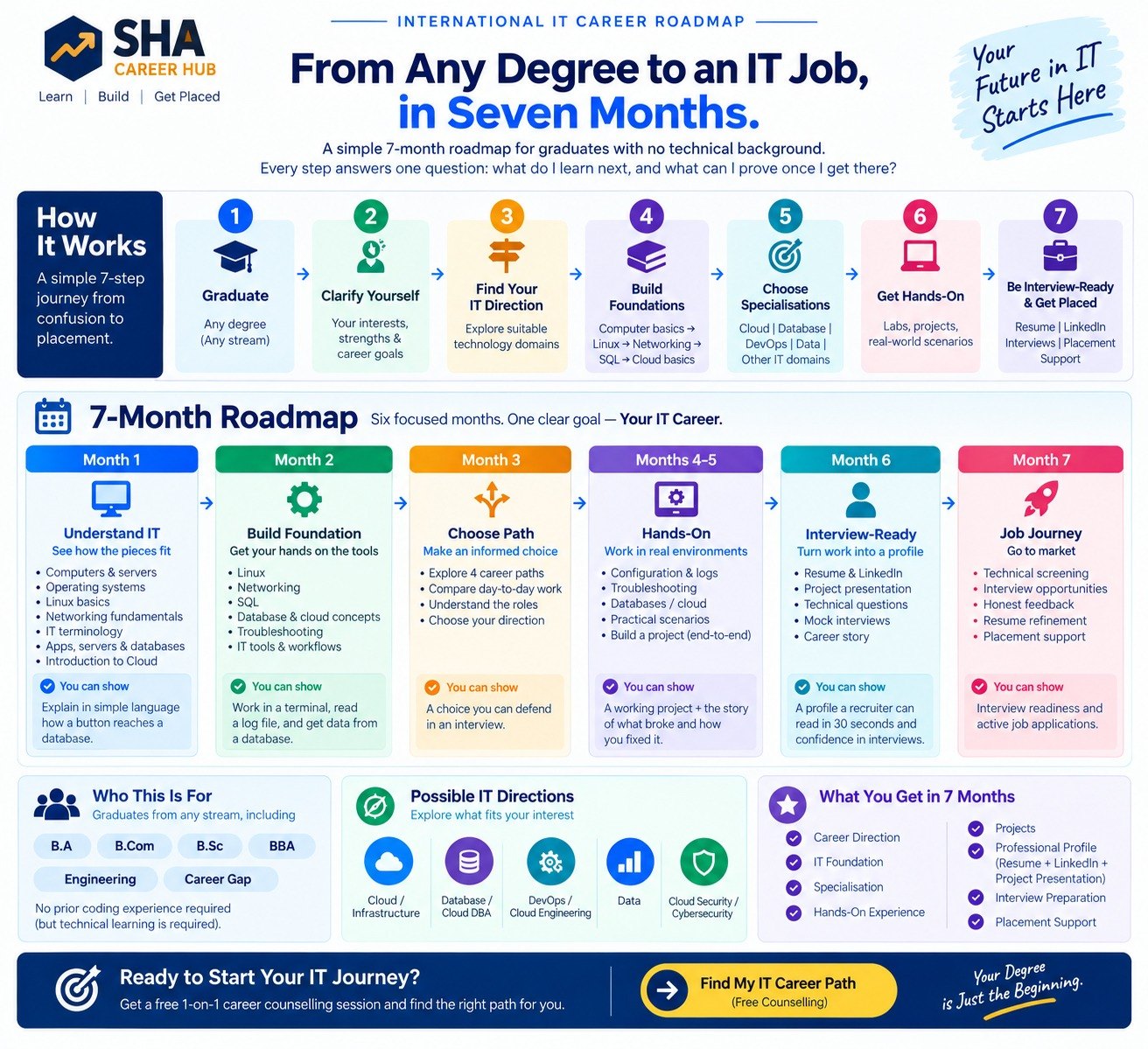
Each stop adds one layer of understanding and one piece of evidence. Nothing here assumes you have written code before. All of it assumes you will put in real technical study. One line for the first three months: everyone learns the same fundamentals. At Month 3 the line splits, and you stay on the branch you choose.

Month 1

Understand IT

See how the pieces fit

Computers and servers, operating systems, an introduction to Linux, and how networks carry information. How an application, a server and a database actually talk to each other.

What you can showYou can explain, in plain language, what happens between someone clicking a button and a database answering.
Month 2

Foundation

Get your hands on the tools

Linux, networking and SQL in practice. Database and cloud concepts. Structured troubleshooting, and the everyday tools and workflows IT teams actually use.

What you can showYou can work in a terminal, read a log file, and get an answer out of a database without help.
Month 3

Choose path

Make an informed choice

Explore the four career paths with enough real context to judge them. Compare the day-to-day work, not the job titles. Then commit to one direction.

What you can showA choice you can defend in an interview, with a reason that isn't "it pays well".
Months 4 to 5

Hands-on

Work in real environments

Configuration, logs and troubleshooting inside your chosen area. Practical scenarios, labs and a project you carry from empty to working.

What you can showA working project, plus the story of what broke along the way and how you found and fixed it.
Month 6

Interview-ready

Turn the work into a profile

Resume and LinkedIn rebuilt around evidence. Your project explained as a story. Technical question practice and mock interviews until the answers are steady.

What you can showA profile a recruiter can read in thirty seconds, and a technical screen you can get through without freezing.
Month 7

Job journey

Go to market

Technical screening, interview opportunities and honest feedback after each one. A job-search strategy you run yourself, with placement support behind it.

What you can showApplications going out to real roles, and a feedback loop that makes each interview better than the last.
SHA Career Hub International IT Career Roadmap poster: from any degree to an IT job in seven months, the seven-step journey, the 7-month roadmap month by month, who it is for, possible IT directions and what you get
The roadmap on one page. Open full size · Download the six-page PDF
Chapter three

Four directions, not four courses

At Month 3 you pick one branch. These four share the same foundation, Linux, networking, SQL and cloud, which is why the first two months are identical, and why moving between them later is realistic.

Cloud and infrastructure

Servers, cloud platforms and the operations that keep systems available. The work is about how technology actually runs, day after day.

Suits you if
You want to know how things work underneath, and you don't mind being the person who keeps them up.
Typical first roles
Cloud support associate, systems administrator, junior cloud engineer
Programs on this branch
AWS, Microsoft Azure, Oracle Cloud (OCI), Multi Cloud Administrator

Database and cloud DBA

SQL, databases and reliability. Structured data, backups and recovery, performance, and making sure information is correct and safe.

Suits you if
You are methodical and careful, and you like structure and clear rules more than constant novelty.
Typical first roles
Database support engineer, junior DBA, data operations associate
Programs on this branch
Database Architect, PostgreSQL DBA

DevOps and cloud engineering

Automation, deployment and operations. The connective work between people who write software and the infrastructure it runs on.

Suits you if
You enjoy removing repetitive work, and you like solving problems while something is actively going wrong.
Typical first roles
Junior DevOps engineer, build and release associate, platform support engineer
Programs on this branch
The DevOps, Terraform and CI/CD modules inside AWS and Azure, and the automation track of Multi Cloud Administrator

Data

SQL, analysis and data workflows. Turning raw records into answers a business can act on, and building the pipelines that keep them flowing.

Suits you if
You like patterns and business questions, and you want your work read by people outside the IT team.
Typical first roles
Data analyst, reporting analyst, junior data engineer
Programs on this branch
Data Science with Python, and Generative & Agentic AI if you would rather build with AI models than analyse data

Cloud security is not a fifth branch here: identity and access management, network security and services such as Cloud Guard are part of every cloud program, because every one of these roles is expected to know them.

Why these paths, and why now

The fastest-growing skills in the world, and where we teach them

  1. AI and big data — the Generative & Agentic AI program and Data Science with Python.
  2. Networks and cybersecurity — networking, identity and cloud security sit inside every cloud program. We do not run a separate cybersecurity course, and we would rather say so than imply one.
  3. Technological literacy — the Linux, networking, SQL and cloud fundamentals that open every track, and the Foundation Program for anyone starting from zero.

Those are the three fastest-growing skills worldwide through 2030, in that order, and each one maps onto something we actually teach. They are drawn from a survey of more than 1,000 employers representing over 14 million workers across 22 industries and 55 economies. Technology roles also dominate the list of fastest-growing jobs, led by big data specialists, AI and machine learning specialists, and software developers.

The same report puts analytical thinking, resilience and adaptability, and curiosity and lifelong learning alongside the technical skills. That combination is the actual job description, and it is the reason a graduate from a non-technical stream is not starting from zero.

These paths also travel. Linux, networking, SQL and cloud fundamentals are hired the same way in London, Dubai, Toronto, Singapore and Bangalore, which makes them among the more portable entry points in technology, for relocation and for remote work.

Source: World Economic Forum, Future of Jobs Report 2025.

What this roadmap does not promise
  • No prior programming experience is needed to start. The roadmap begins at fundamentals.
  • Real technical learning is still required, and seven months of it is demanding. There is no version of this that is easy.
  • You go deep on one direction. Sampling all four is how people finish with no evidence in any of them.
  • Designed for graduates of any recognised stream, B.A., B.Com, B.Sc, BBA, BCA and engineering, including those returning after a career gap.
How to join

A simple five-step process to get started

The same process for every program. It is fair and transparent on both sides: you get to prove your fit, and we both decide after the first sessions whether to continue.

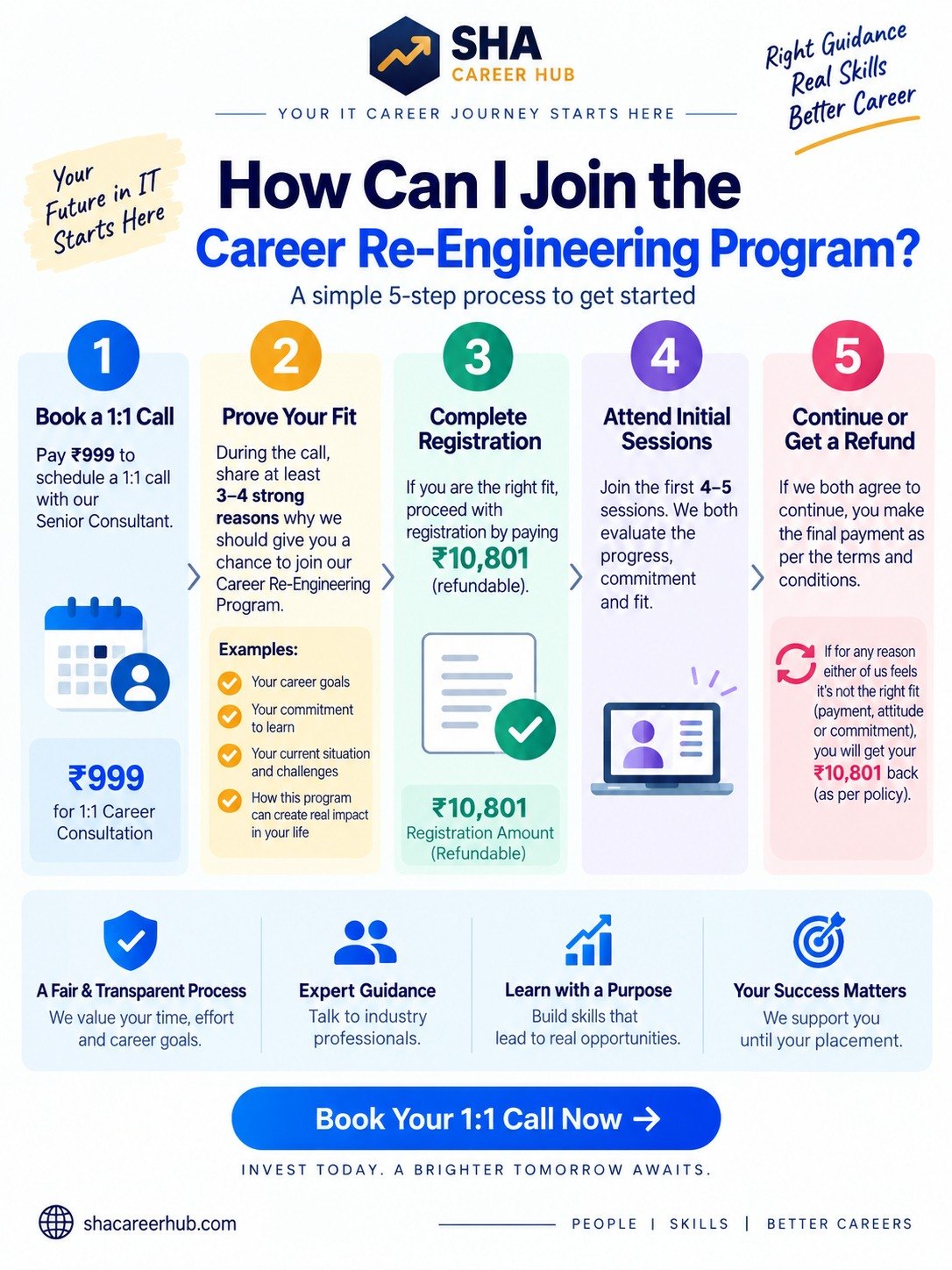
How can I join the Career Re-Engineering Program: a simple five-step process. 1 Book a 1:1 call, 2 Prove your fit, 3 Complete registration, 4 Attend initial sessions, 5 Continue or get a refund
Open full size
  1. Book a 1:1 callAttend your free counselling call first. If it looks like a fit, pay ₹999 to book a one-to-one call with our senior consultant.
  2. Prove your fitDuring the call, share at least three or four strong reasons why we should give you a chance: your career goals, your commitment to learn, your current situation and challenges, and how the program can create real impact in your life.
  3. Complete registrationIf you are the right fit, proceed with registration by paying ₹10,801 (refundable).
  4. Attend the initial sessionsJoin the first four or five sessions. We both evaluate the progress, commitment and fit.
  5. Continue, or get a refundIf we both agree to continue, you make the final payment as per the terms and conditions. If for any reason either of us feels it is not the right fit (payment, attitude or commitment), you get your ₹10,801 back, as per policy.

Book the 1:1 call after you have attended your first free counselling call — ask for a callback and we will arrange it.

Months six and seven, in detail

Six placement steps, no shortcuts

Finishing the course is the halfway point. What happens after your final module is what most institutes leave to chance, and what we treat as the main event.

Career clarity

Before day one: a one-to-one call with a senior consultant maps your background to a realistic target role, so you never train toward the wrong goal.

Skills: zero → specialisation

Seven months of live classes, labs and a capstone project take you to the depth MNC interviews actually test.

Tech screening

We evaluate your technical skills, communication and confidence — and close the gaps before recruiters ever see you.

CV built to industry standard

Your resume is rebuilt with recruiter-approved templates and your real project work — the profile MNCs shortlist.

Profile marketing + mock interviews

We coach you on where and how to apply, then run mock interviews with recruiters and industry experts until you're clearing them consistently.

Placed — and supported

Assistance continues through real interview calls until you sign an offer. Your success is the metric we run on.

Hiring network

Where our alumni work today

TCS Infosys Wipro HCL IBM Oracle Deloitte PwC Cognizant Capgemini Tech Mahindra LTIMindtree Mphasis DXC Technology Kyndryl NTT DATA CGI Birlasoft JP Morgan SBI UCO Bank Bharti Airtel Ericsson Huawei Tata Power Hitachi Fujitsu Translab.io
Roadmap questions

Before you commit to anything

Do I need to know programming before I start?

No. The roadmap begins at fundamentals: computers and servers, operating systems, Linux, networking and SQL. Nothing in the first three months assumes you have written code. Real technical study is still required, and seven months of it is demanding.

Which degrees is the seven-month roadmap for?

Graduates of any recognised stream: B.A., B.Com, B.Sc, BBA, BCA and engineering, including people returning after a career gap. The first two months are identical for everyone, which is why a non-technical degree is not a disadvantage at the start.

How do I choose between cloud, database, DevOps and data?

In Month 3, after two months of fundamentals, you explore the four directions with enough real context to compare the day-to-day work rather than the job titles, then commit to one. The one-to-one call with our senior consultant before you start gives a first recommendation based on your background and what you enjoy.

What will I be able to show an employer after seven months?

A working project you carried from empty to working, with the story of what broke and how you fixed it; a resume and LinkedIn profile built around that evidence; steady answers in technical screens and mock interviews; and applications going out to real roles with placement support behind them.

Why go deep on one direction instead of learning all four?

Because employers now hire on evidence, not on a list of technologies. Sampling all four is how people finish with no evidence in any of them. The four share the same foundation of Linux, networking, SQL and cloud, so moving between them later is realistic.

Are these skills useful outside India?

Yes. Linux, networking, SQL and cloud fundamentals are hired the same way in London, Dubai, Toronto, Singapore and Bangalore, which makes them among the more portable entry points in technology, for relocation and for remote work.

Real stories from people who followed this route are on the blog under Success Stories, and the FAQ covers fees, batches and eligibility.

Not sure which of the four fits you?

Start with a one-to-one call with our senior consultant (₹999). We'll look at your background, what you actually enjoy doing, and which branch is the realistic one for you, before you commit to anything.

Check My IT Career Eligibility